


VitalHip
TRIPLE-ACTION THERAPY"The NHS gives you a date. Nobody gives you a plan. This is the plan — 15 minutes every evening, in your own chair, while you wait."
Your surgery has a date. Your recovery doesn't — unless you give it one. Fifteen minutes, every evening, while you wait.
Couldn't load pickup availability


Ideal for
VitalHip was designed for people living with:
- Hip pain that burns into your groin or runs down the front of your thigh
- Nights that end at 3:17am — unable to lie on your side, a pillow between your knees, or sleeping in the armchair because the bed has become torture
- A day planned around one flight of stairs — and an upstairs loo you've started avoiding
- Being on the NHS waiting list, with months between your diagnosis and your date and nobody telling you what to do in between
- Painkillers that take the edge off but never touch the problem — and a quiet voice that counts the tablets
- A steroid injection that worked the first time, barely the second, and nobody explained why
- A drawer full of small kindnesses: the cushion, the wedge, the wheat bag, the TENS machine with tangled wires
- Being told "just manage it until your date" — with a wheat bag and a sympathetic tilt of the head
If the hardest part isn't the operation but the months of waiting before it, this was built for you.
Full specifications
- Deep compression: rhythmic air-pressure chambers work the muscles wrapped around your hip, loosening the guard that clamps down on the nerves running to your groin and thigh
- Therapeutic warmth: a steady, comfortable 50°C sinks deep into the tissue around the joint, reopening blood flow to starved, switched-off muscle
- Red & near-infrared light: a panel of 660nm and 850nm LEDs reaches into the muscle cells and wakes their energy factories — so the crew doesn't just stir, it stays awake
- Format: cordless, rechargeable fabric wrap with adjustable straps. One button. Built-in 15-minute automatic cycle. Use it sitting in your own chair
- Ritual: every evening, 15 minutes. The cycle runs the three phases in sequence: Loosen, Flood, Switch On
- Safety: drug-free, non-invasive, nothing that interacts with your prescriptions. Designed to work alongside your GP's and surgeon's care, not instead of it — if your surgeon says it's time for your operation, you go. VitalHip is the plan for the months in between
How is this different from what I've already tried?
Everything you've tried so far only ever touched one piece of the problem. Tablets mask the pain but the guarding muscles stay clamped, so the nerves keep shouting. A massage feels lovely and fades by morning, because a starved muscle simply clamps again. The wheat bag warms the skin while the clamp wins underneath. The gadgets in your drawer each did one job — never all three.
Waking a sleeping crew needs three things at the same time: compression to loosen the guard, warmth to flood the starved tissue, and red light to switch the muscle's energy back on. Miss even one and the relief never lasts. VitalHip runs all three, in the right sequence, in one 15-minute cycle.
Your treatments were never wrong. They were just never aimed at all three thieves at once.
They told me it's "bone on bone". How can a device help?
"Bone on bone" is real — your X-ray isn't lying, and we will never tell you a wrap regrows cartilage. It doesn't.
But your hip joint doesn't carry you. It never has — it's a hinge. The thing that carries you is the crew of muscles wrapped around it, and when a joint hurts, your nervous system switches that crew off. Month after month on the waiting list, the muscles weaken, the blood flow drops, and the pain gets louder — while the X-ray looks "stable".
VitalHip exists for that window: it keeps the crew awake and working while you wait, so your nights are quieter now and you arrive at your date stronger. Many of our customers keep their surgery date and use it every evening until the day itself.
Who should not use this?
We would rather lose a sale than sell to the wrong person. Some symptoms are true emergencies.
If you've had a fall and suddenly cannot put any weight on the leg, if the joint is hot, red and swollen and you have a fever, or if you have new numbness around your groin or new problems controlling your bladder or bowels — that is not what this page is about. Call 999 or go straight to A&E.
If you've recently had a hip operation, follow your surgeon's instructions first and ask them before using any device on the area.
Is it complicated to use?
No. Sit in your favourite chair, wrap it around your hip, press one button, and let the 15-minute cycle run. Once a day, at home, whenever it suits you. Most people use it in the evening, in front of the telly, before bed.
No app, no assembly, nothing to learn. As one of our customers — June, 74, who once phoned her son to ask how to open a PDF — put it: "Sit, wrap, press."
Delivery, returns and guarantee
Delivery: dispatched from our UK fulfilment centre, with tracked delivery in 3 to 5 working days.
90-Night "Sleep On It" Promise: use VitalHip every evening for up to ninety nights. If your nights aren't quieter, if the stairs aren't easier, send one email to info@healthvital.co.uk and we refund every penny — we even cover the return postage anywhere in the UK. No forms, no interrogation.
1-year warranty: if anything stops working the way it should in the first year, we replace it. Simple as that.
Only available at Health Vital
VitalHip is sold exclusively on this official site. It is not available on Amazon, not in Boots, not anywhere else.
Look-alike wraps sold elsewhere don't have the sequenced 15-minute cycle, the dual-wavelength red light panel or the calibrated therapeutic warmth — and they don't carry our 90-Night Promise, which is only valid for orders placed on this page.
No referral, no appointment, no waiting list. Just the device, delivered direct to your door.
VitalHip™


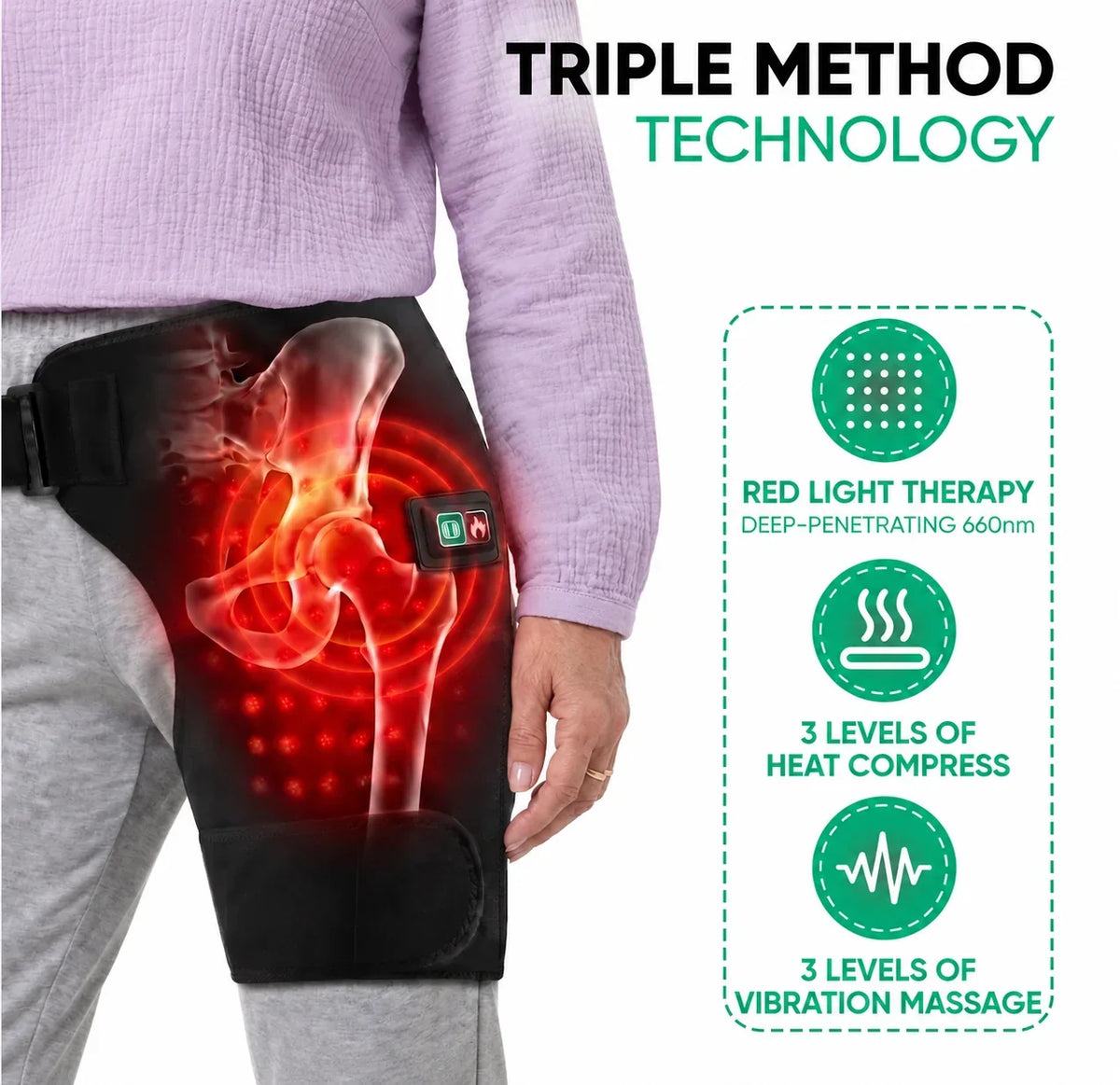
The Triple-Action Therapy
To Loosen, Flood and Switch On Your Hip's Crew
Deep Compression: The Loosen
The release your nerves have been waiting for. Rhythmic air-pressure chambers work the muscles clamped tight around your hip, easing the guard that squeezes the nerves running to your groin and thigh. Most people feel the first let-go within minutes.
Therapeutic Warmth: The Flood
The circulation your starved crew has been missing. A steady, comfortable 50°C sinks deep into the tissue around the joint, reopening blood vessels and dragging oxygen back into months of drought. Without it, the muscle stays cold, stiff and hungry.
Red Light: The Switch On
The step everything else misses. A panel of 660nm and 850nm LEDs reaches into the muscle cells and wakes their tiny energy factories — so the crew doesn't just stir for an hour, it stays awake. Without it, the relief always fades by morning.
Less than one private physiotherapy session.
A course of private physiotherapy runs £300–£600, and you'll be offered it twice a week for months. A steroid injection costs £150–£300 privately and works less each time — your GP already knows that. The painkillers quietly add up to £100–£200 a year. The drawer of cushions, wedges, wheat bags and gels is probably holding £150–£400 already. And going private for the operation itself costs £12,000–£16,000. None of them gave you a plan for the waiting months, because none of them wakes the crew around your hip day after day. No waiting list. No referral. No rationing. 15 minutes an evening, once, for £59.90.


Fifteen minutes, every evening. That's the whole routine.
Sit in your favourite chair, fasten the wrap around your hip and press one button. In the first five minutes the compression chambers loosen the muscles clamped around your nerves. In the next five, therapeutic warmth at 50°C soaks deep into the starved tissue around the joint. In the last five, the red light switches the muscle's energy factories back on. Then it switches itself off. No app, no assembly, nothing to learn, and no one needs to know you use it. Keep it by your chair, ready for the evening. If you can sit down, you can use this.
They stopped just waiting. Here's what happened.
VitalHip is used by people who spent months being managed instead of helped: co-codamol counted out against the night, a steroid injection that worked less the second time, a wheat bag, a TENS machine, a drawer full of gadgets. Most of them were told to "just manage it until your date". Here's what they say about it.


One wrap against the whole drawer
Let's compare VitalHip with what's sitting in your drawer (the wheat bag, the TENS machine, the gels) and with what the private route keeps charging you for.
Triple-Action Therapy
Frequently asked questions
Need more answers?How is this different from cheaper hip wraps I've seen on Amazon?
Will it actually work for my specific diagnosis?
I'm 66. Isn't this just wear and tear, or just my age?
I've already tried physio, painkillers and a steroid injection. Why would this be different?
How long until I'll feel a difference?
How is this different from my TENS machine or a wheat bag?
I'm on co-codamol or other prescriptions. Can I use it?
I'm on the waiting list for a hip replacement. Is that a problem?
How often should I use it?
Is it difficult to set up or heavy to move?
What if it doesn't work for me?
Fourteen months on the list, left hip. I did a lot of research before ordering, because I have a drawer full of things that did not work: a TENS machine, two wheat bags, a special cushion, a massage gun I used twice. I even saw a cheaper lookalike on Amazon and nearly fell for it. First week with VitalHip I slept until 5:40, and I lay there listening to the quiet and cried — not from pain, from quiet. By week four I was climbing the stairs without planning them first. It is the first thing from the internet that did what it said. I still have my surgery date. And now I have a plan for the months before it.

I live alone and had my date in June. Three months of using it every evening and I walked into that hospital actually strong. Home in three days. The physio asked what I'd been doing. You're not powerless in the wait — that's the whole point of this wrap.

I'm 69, right hip gone after 40 years on building sites. Co-codamol was the only thing that ever helped, but the dose that worked fogged my head so badly I cut it down two years ago. This bypasses all of that. I put it on after dinner, fifteen minutes, done. The relief holds past breakfast, which no tablet ever did. The pillow between my knees has been retired.

Bought this for my mum, 78, after her GP said it was wear and tear and to manage it with painkillers until her date. She's stubborn and told me not to waste the money. She now rings me to talk about her roses instead of her hip. "You're the favourite daughter now," as she puts it. Simple enough that she uses it on her own every evening, which says a lot.

My husband's hip has been going for six years, and the consultant said the best plan was to wait for the list. That word did not sit well with either of us after 41 years of marriage. Three months in, he walked our daughter down the aisle and stayed on his feet until the last dance. The stick isn't by the door anymore. The fear mostly isn't either. We should have ordered two.

I'm 72, hopeless with technology, nine years of hip trouble, and I was so tired of being brave about it. It's one button. Sit, wrap, press. I kept a little log in my diary because I didn't trust it: day 11, slept past 5am; week five, made it round the garden centre without hanging off the trolley; week eight, off the extra pillows entirely. My niece says I sound younger on the phone.
